Views: 0 Author: Site Editor Publish Time: 2026-06-16 Origin: Site


Urban planners and architects face a difficult infrastructure dilemma today. They must secure high-risk public spaces like bridges, overpasses, and viewing platforms. At the same time, they cannot compromise existing structural integrity or original architectural vision. Traditional safety barriers often fail to balance these competing demands effectively. Heavy steel fencing and solid glass panels introduce severe wind load issues. Standard polymer nets obstruct scenic views and degrade rapidly under harsh UV exposure. This forces structural engineers into a constant compromise between aesthetic beauty and public safety.
We now have a proven way to break this frustrating cycle. A highly engineered stainless steel rope net system offers a compliant, non-invasive alternative. It delivers immense tensile strength without visually overpowering the structure. You can achieve comprehensive multi-hazard protection while maintaining a remarkably discrete, lightweight footprint. Read on to learn how this specialized material transforms modern infrastructure safety.
Multi-Hazard Mitigation: Effectively deters suicides, prevents accidental falls, and blocks malicious anti-throw events while maintaining architectural transparency.
Lifecycle ROI: 316 marine-grade stainless steel delivers a 30+ year service life with virtually zero maintenance, outperforming traditional polymer safety nets.
Structural Compatibility: High strength-to-weight ratio minimizes added dead load, making it ideal for both modern curved 3D architecture and historic bridge retrofits.
Specification Variables: Balancing cable diameter, mesh aperture, and tension is critical for meeting specific municipal load ratings and safety compliance standards.
We often witness a historical friction in structural design. Architects want ultimate transparency, flowing lines, and sweeping natural vistas. Conversely, safety engineers demand robust fall-arrest systems and secure barricades. Finding a true middle ground proves extremely difficult. Public spaces require strict physical barriers to protect citizens effectively. Yet, heavy metal barricades quickly turn elegant bridges into ugly visual fortresses.
A comprehensive safety barrier must mitigate three primary risk categories. Engineers refer to these specific scenarios as multi-hazard threat models:
Fall Protection: This involves standard pedestrian edge protection. You see it frequently on pedestrian railings, observation decks, and multi-storey car parks. Visitors often face extreme heights near open edges. You must provide a fail-proof physical barrier to stop accidental slips.
Suicide Prevention: Bridges over deep gorges or highways sadly attract self-harm attempts. Planners carry a moral obligation to intervene physically. You must create un-climbable, high-barrier perimeters. These structures must deter attempts immediately without visually enclosing the public space.
Anti-Throw Screens: Malicious actors sometimes drop heavy debris onto underlying roadways. This creates massive hazards for moving vehicles below. A tight wire screen effectively blocks these malicious events. It catches rocks, bottles, and dangerous projectiles instantly.
Legacy solutions struggle terribly to address these three threats simultaneously. Rigid barriers create incredibly high wind loads. They add immense structural stress to older bridges during severe storms. Furthermore, they cause significant visual blockage for pedestrians and drivers. Alternatively, traditional polymer nets lack long-term durability. They suffer from rapid UV degradation and offer much lower tensile strength. Their short lifespan makes them highly unsuitable for permanent public infrastructure upgrades.
Material superiority heavily defines the success of modern barrier systems. A 316 marine-grade stainless steel safety net outclasses high-strength polypropylene (PP) nets entirely. It provides extreme structural resilience and unmatched corrosion resistance. PP nets lose strength under constant sun exposure. In contrast, 316-grade steel ignores UV rays completely. It utilizes added molybdenum to resist pitting and rusting. It maintains its massive tensile strength through decades of harsh coastal weather.
Visual impact remains surprisingly minimal. The discrete appearance of wire mesh preserves scenic vistas perfectly on high bridges. In enclosed spaces like parking garages, it allows natural light to flow freely. This high transparency drastically reduces the need for artificial lighting during the day. You also save on mechanical ventilation costs. Fresh air moves effortlessly through the open wire mesh.
Engineers highly value its lightweight, non-invasive flexibility. Heritage bridges often cannot support increased structural dead-loads safely. Wire mesh provides a perfect retrofitting solution for these scenarios. It adds very little weight to the aging masonry or iron framework. Furthermore, it easily conforms to complex, 3D curved architectural profiles. You achieve stunning geometric shapes without ever losing critical structural integrity.
Lifecycle economics strongly favor this metallic approach. You can comfortably expect a 25-year, maintenance-free service life. The initial capital expenditure (CAPEX) might look higher than polymer netting. However, the operational expenditure (OPEX) drops essentially to zero over the decades. You only need routine environmental cleaning and basic visual inspections. You never have to budget for a complete net replacement every five years.
Material Type | UV Resistance | Wind Load Impact | Service Life Expectancy | Visual Transparency |
|---|---|---|---|---|
Polymer Netting (PP) | Poor (Degrades rapidly) | Low | 3 to 5 Years | Moderate |
Solid Glass Panels | Excellent | Extremely High | 15 to 20 Years | High (Requires frequent cleaning) |
316 Stainless Wire Mesh | Excellent | Very Low | 30+ Years | Very High |
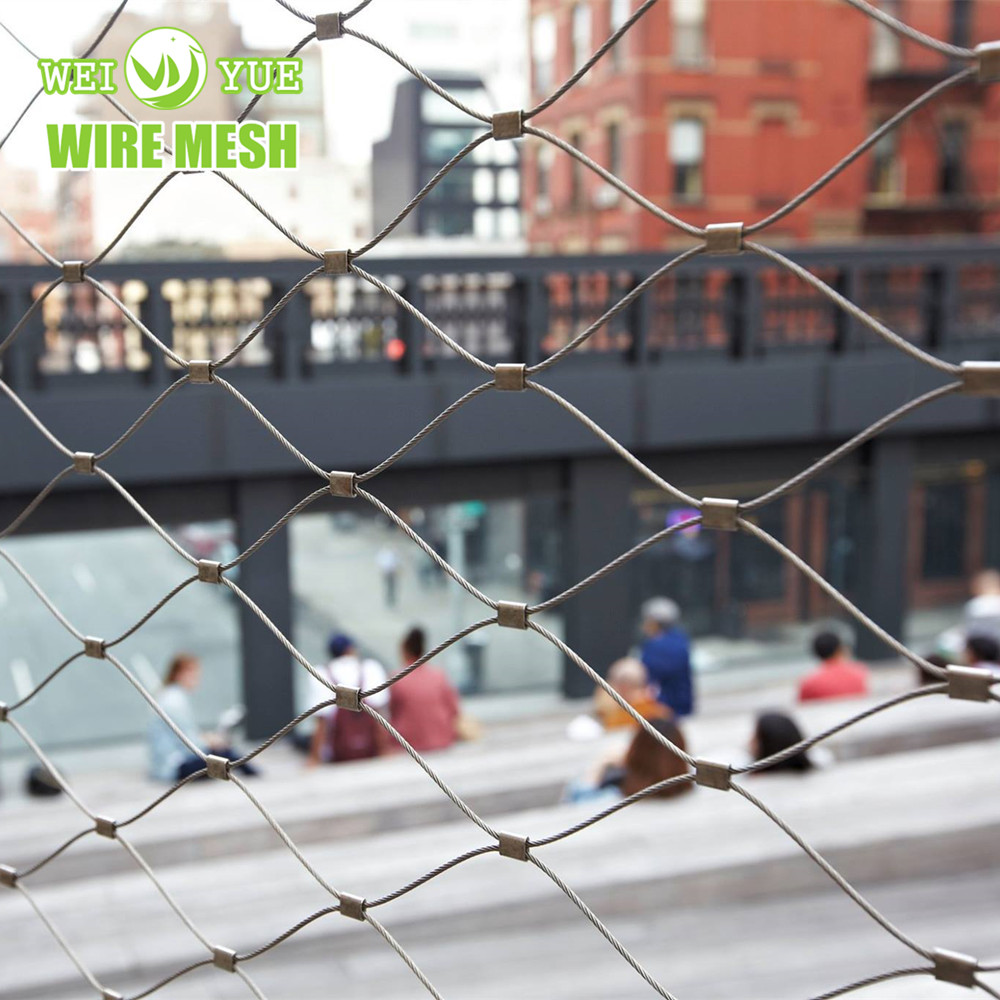
Engineers and architects need an objective, variable-control evaluation framework. Specifying the correct mesh requires balancing several distinct physical variables. You must align these specs precisely to your exact project demands. A minor miscalculation in wire size can alter the entire safety rating.
A clear trade-off exists between physical strength and optical visibility. Thicker cables, such as 3.2mm (1/8 inch), offer massive break loads. They can securely hold up to 1600 lbs of dynamic force. However, they naturally reduce overall visibility for pedestrians. Conversely, thinner cables like 1.2mm (3/64 inch) maximize architectural transparency. They virtually disappear against the sky from a distance. You must match thinner cables exclusively to low-risk pedestrian zones. They simply cannot handle heavy dynamic impact loads from crowds.
You must scale the hole size directly to the specific environment.
Small apertures (1"x1" or 1.5"x1.5"): These are strictly mandatory for high-pedestrian areas. You need them around families and small children to prevent entanglement. They also serve perfectly for anti-climb and anti-throw applications. Small holes eliminate toeholds and finger grips completely.
Large apertures (2"x2" to 3"x3"): These work exceptionally well for lower-risk areas. You can use them primarily as secondary containment barriers. They offer excellent visibility where direct human impact remains highly unlikely.
Proper initial tensioning stands as a strictly non-negotiable installation factor. You must apply the exact specified tension during the setup phase. This crucial step prevents long-term sagging across the span. It also maintains the specified nominal break load indefinitely. A loose net loses its kinetic impact-absorption qualities immediately. Safety engineers usually calculate a five-to-one safety factor for dynamic loads. If a crowd surges against a railing, the mesh must distribute that kinetic energy safely. It transfers the force directly to the rigid perimeter tubes.
Cable Diameter | Aperture Size | Primary Application Segment | Nominal Break Load Estimate |
|---|---|---|---|
1.2mm (3/64") | 2" x 2" | Low-risk railing visual infill | ~270 lbs |
1.5mm (1/16") | 1.5" x 1.5" | Standard pedestrian fall protection | ~650 lbs |
2.0mm (5/64") | 1" x 1" | Anti-climb / Anti-throw security screens | ~900 lbs |
3.2mm (1/8") | 3" x 3" | Heavy duty secondary containment | ~1600 lbs |
Bridge and public area safety upgrades follow notoriously long project life cycles. They are highly scrutinized, publicly funded municipal projects. You must navigate complex approval processes, environmental reviews, and public hearings. Managing stakeholder expectations requires hard data and visual proof.
Prototyping and empirical load testing are absolutely essential for success. You must work with specialized vendors who provide preliminary material sampling. They should offer detailed empirical load test calculations upfront. Furthermore, they must heavily support on-site mockup capabilities. You cannot deploy a massive full-scale mesh without testing a physical prototype first. A well-built mockup builds immense trust among skeptical municipal stakeholders. It proves the concept works visually and structurally.
Regulatory and certification standards guide the entire civic approval process. We strongly advise buyers to look for materials aligned strictly to global standards. Look specifically for ISO certifications, EN 1090 compliance, or DIBt equivalents. Approved materials ensure remarkably smooth government and community approvals. If a product lacks proper engineering certification, building inspectors will reject the installation immediately.
Installation fundamentally requires highly specialized, certified contractors. A tensioned safety system is only as strong as its surrounding anchoring framework. The pre-tensioning process demands specialized clamping tools and rigorous technical training. Inexperienced crews often fail to balance the tension evenly across large spans.
Always request a small-scale physical mockup for public review early in the timeline.
Verify marine-grade 316 chemical composition certificates before signing purchase orders.
Involve structural engineers immediately to assess the load capacity of existing anchor points.
Specify exact turnbuckle and eye-bolt grades to match the mesh strength.
Specifying large apertures in areas heavily prone to malicious debris throwing.
Allowing uncertified general contractors to handle complex mesh pre-tensioning procedures.
Ignoring the subtle added wind load calculations on severely aging heritage structures.
Failing to account for thermal expansion in long perimeter cables during summer heat.
A stainless steel rope net serves as much more than just a raw building material. It acts as a fully engineered, multi-hazard safety solution. It completely resolves the historical conflict between architectural form and civic function. You can protect vital public infrastructure without destroying its intrinsic beauty. This material guarantees long-term performance under the harshest environmental conditions.
Take action today to improve the safety profile of your upcoming structural projects:
Consult your engineering teams early in the conceptual design phase to integrate perimeter frames.
Determine precise dynamic load requirements before officially selecting the mesh geometry.
Request physical material prototypes to evaluate visual transparency accurately on site.
Verify all municipal compliance codes and safety standards prior to full-scale procurement.
A: It performs exceptionally well. The open mesh allows violent wind shear to pass right through. This eliminates the heavy structural stress common to solid barriers. Furthermore, the 316-grade stainless steel provides complete rust immunity. It easily resists heavy ice-loads, freezing rain, and coastal salt spray without degrading over time.
A: Yes, they are highly suitable for sensitive heritage retrofits. We focus on non-invasive anchoring options. The incredibly lightweight nature of the mesh prevents overstressing old structural supports. It provides modern safety compliance without requiring major architectural modifications to the original historic bridge framework.
A: The maintenance requirements remain incredibly low. You do not need frequent re-tensioning if specialized contractors install the system correctly. Maintenance primarily limits itself to routine visual inspections of the perimeter cables. You only need basic environmental cleaning with water to wash away urban dust and maintain the aesthetic shine.
A: No. When you specify the correct small aperture size and diamond-mesh geometry, it completely eliminates footholds. Fingers and shoe tips cannot penetrate the small gaps. This makes the barrier physically un-climbable, effectively deterring suicide attempts and stopping unauthorized access to restricted public zones.