Views: 0 Author: Site Editor Publish Time: 2026-06-15 Origin: Site


Designing modern architectural barriers requires immense precision and foresight. Structural engineers and architects face a vital choice when specifying flexible mesh systems. Choosing the wrong stainless steel rope net is rarely just an aesthetic decision. It strictly dictates long-term structural safety. The incorrect mesh type inflates international shipping freight drastically. It also increases the structural dead load on delicate supporting frameworks. Sometimes, it can even fail entirely under extreme dynamic stress. Project managers must get this right from the start.
We provide an objective, engineering-focused comparison between ferrule and knotted configurations. You will learn how to align material properties with your exact project constraints. We guide you through span requirements, budget limits, and safety compliance standards. This ensures you make the safest, most effective choice. Your final specification determines the visual and structural success of your entire installation.
Structural Mechanism: Ferrule mesh uses stamped metal sleeves to join cables for precise geometry, while knotted mesh relies on purely mechanical interlocking.
Impact Resistance: Knotted structures offer superior topological rigidity under localized impact, whereas heavy ferrule sleeves can theoretically slip under extreme, non-uniform stress.
Weight & Logistics: Ferrule rope nets are heavier due to the added sleeves, impacting both structural dead load and international freight costs.
Best Fit: Ferrule mesh dominates high-end architectural facades and commercial staircases; knotted mesh is the industry standard for large-span aviaries, zoos, and weight-sensitive marine netting.
Let us define the solution categories first. Manufacturing methods strictly dictate performance metrics. You must understand how the individual wire ropes connect before specifying a system.
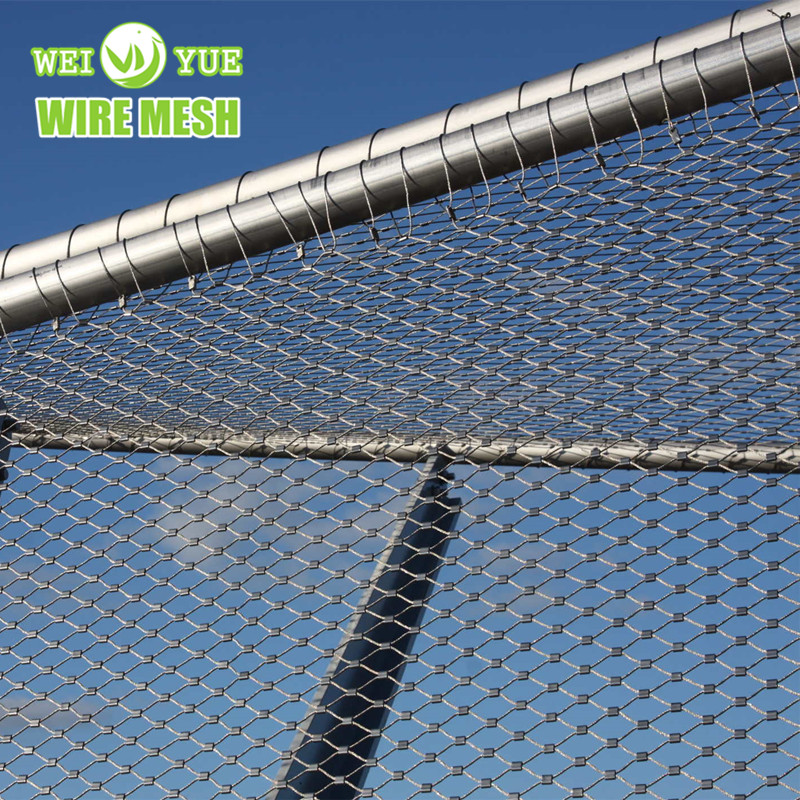
A ferrule rope net binds intersecting wire ropes mechanically. Factories use seamless or stamped stainless steel sleeves. These sleeves are known industrially as ferrules. They clamp intersecting 7x7 or 7x19 wire ropes together permanently. Machines crimp these metal ferrules under massive hydraulic pressure. This forms an immovable, rigid joint.
The tensioning process is highly engineered. It distributes structural loads evenly across the entire mesh panel. This engineered tension maintains highly symmetrical and predictable diamond patterns. Structural engineers rely heavily on this strict geometry. It guarantees uniform load distribution across large building facades. The uniform layout looks exceptionally clean and professional.
Knotted mesh takes a fundamentally different manufacturing approach. Cables are manually or mechanically interwoven. They cross over each other without any auxiliary fasteners. The structure features absolutely no extra metal sleeves. The tensioning relies entirely on a topologically fixed knot.
It uses purely the tensile strength of the stainless steel wire itself. This creates a highly flexible, fabric-like barrier. The interwoven nature provides extreme topological rigidity. It will not deform easily under sudden point loads. The mechanical interlocking allows the net to act like a woven metallic fabric. It flexes naturally under pressure without compromising the geometric integrity of the adjacent nodes.
Procurement managers need a reliable side-by-side comparison. Project realities quickly highlight the operational differences between these two systems. We built an evaluation framework to guide your shortlisting process effectively.
Evaluation Dimension | Ferrule Mesh | Knotted Mesh |
|---|---|---|
Weight Profile | Heavy (due to metal sleeves) | Lightweight (high strength-to-weight ratio) |
Impact Resistance | Good (sleeves may slip under extreme loads) | Superior (topologically fixed knots) |
Visual Transparency | Structured, visible architectural lines | Highly transparent, nearly invisible |
3D Flexibility | Limited to mostly flat or gentle curves | Extreme malleability for complex shapes |
Standard Tension Angle | 60° (custom 20°-75° available) | 90° (square-like stretch) |
We must address the reality of structural weight first. Ferrules add significant mass per square meter. A heavier panel increases the dead load on architectural columns. You must engineer stronger peripheral frames to support this added weight. Reality check: For large-scale projects, knotted mesh offers a substantially higher strength-to-weight ratio. It removes thousands of heavy metal sleeves from the overall equation. This directly reduces volume-weight shipping costs. Sea and air freight become significantly cheaper for international logistics.
Risk assessment plays a crucial role in mesh selection. Structures face extreme, sudden impacts regularly. Falling rocks hit canyon bridges. Heavy animals strike zoo enclosures unexpectedly. Knotted mesh absorbs these violent blows effectively. It will not deform unless the actual wire breaks. The topological knot distributes the impact energy dynamically across the surface. Ferrule sleeves behave differently under catastrophic localized stress. They carry a slight risk of sliding. Extreme impacts can cause minor deformation in the diamond pattern, requiring maintenance.
Visual transparency dictates many architectural decisions. A ferrule mesh presents a highly finished, industrial look. It offers a clean, highly structured appearance. Architects often prefer this rigorous symmetry for modern building designs. Knotted mesh acts differently in open spaces. It is far less visually obtrusive. The lack of bulky connecting sleeves makes it nearly invisible from a distance. This distinct characteristic makes it ideal for unobstructed viewing areas.
Complex modern architecture demands extreme structural flexibility. Both nets flex well over flat planes. However, knotted mesh boasts superior 3-dimensional malleability. It wraps seamlessly around highly irregular shapes. You can stretch it over complex funnels or large spheres. It conforms to challenging architectural topologies easily. The wire knots pivot slightly to accommodate complex geometry. Ferrule joints naturally resist this extreme 3D bending. They prefer standard planar tensioning.
Measurement standards vary strictly between the two types. Ferrule meshes are traditionally tensioned at a 60° angle. Installers measure this angle diagonally across the diamond aperture. Custom architectural pulls are completely possible. Ferrule meshes often default to a 90° stretch. Knotted meshes often default to a 90° stretch. This square-like stretch maximizes the open span. It uses the woven geometry perfectly.
You should specify ferrule structures based on clear success criteria. They win effortlessly when aesthetic precision matters most. Choose them when uniform load distribution outweighs strict budget limits.
They fit perfectly in rigid, design-focused environments. Common success cases include:
Commercial staircase balustrades and fall-protection infill panels.
High-end green wall trellises requiring heavy structural rigidity.
Architectural building facades demanding perfect visual symmetry.
Luxury yacht railings and premium pedestrian bridge enclosures.
Watch out for increased dead weight. Heavy metal sleeves demand stronger peripheral frame engineering. You must account for this extra mass during early structural blueprinting. Weak anchor points will fail under the combined weight. Do not underestimate the peripheral tension required. It takes substantial physical force to pull the 60° diamond pattern perfectly tight. Common Mistake: Failing to reinforce the border cables leads to sagging ferrule panels over time.
You must define strict success criteria for knotted systems. They excel when maximizing span is your absolute priority. Choose them to minimize weight and prioritize high environmental transparency.
They naturally dominate large-scale outdoor projects. The best applications include:
Large-span zoo enclosures and open wildlife sanctuaries safe for direct animal contact.
Spacious botanical aviaries requiring a soft, forgiving barrier.
Marine and offshore environments where extreme flexibility effectively dissipates constant mechanical vibration.
Sports stadium safety netting stopping high-velocity balls.
Helicopter pad perimeter barriers resisting severe wind loads.
Knotted structures look much less visually structured. This organic appearance may not align with strict geometric architectural visions. Expect a slightly softer visual boundary. The 90° stretch requires incredibly careful edge finishing. Poorly secured woven borders will sag visibly over wide spans. You must use precise tensioning equipment during installation.
We guide buyers toward authoritative material specifications. You must request precise metallurgical data from manufacturers. Avoid accepting generic material grades. Proper customization guarantees a successful, long-lasting installation.
Material grade dictates survival in harsh environments. We recommend Grade 304 for standard inland use. It handles normal atmospheric moisture extremely well. However, you must mandate Grade 316 or 316L for demanding zones. The 316L variant contains 2-3% Molybdenum. This specific element prevents serious pitting corrosion. You absolutely need it for marine, high-humidity, or coastal projects. Best Practice: Always request a material test report confirming Molybdenum content before authorizing production.
Consider black oxidized mesh for specific lighting conditions. This process chemically alters the steel surface. It is not standard paint. Paint quickly chips and flakes off flexible wire. Black oxide provides excellent, permanent glare reduction. It absorbs sunlight effectively. You see it often in zoo viewing areas. It also works perfectly for stealth architectural features. The dark color tricks the human eye. The barrier seems to disappear entirely against dark backgrounds.
Top-tier manufacturers supply custom, pre-assembled panels. They can weave massive sheets up to 300 square meters. We highly recommend ordering maximum panel sizes. Procurement tip: Ordering maximum panel sizes drastically reduces on-site splicing labor. Hand-splicing panels takes hours of expensive labor. Pre-fabrication effectively eliminates excess material waste. It ensures factory-level tensioning across the entire span.
Factories ship both net types tightly rolled into cylinders. The flexible wire ropes pack down surprisingly well. You must ensure suppliers use proper packaging to avoid damage.
Small Batches: Suppliers use heavy-duty P.P. woven bags. This keeps the roll compact for courier or air freight.
Large Sea Freight: Suppliers must use wooden crates. This prevents catastrophic structural deformation during international transit.
Unpacking Logistics: Installers simply unroll the cylinder like a giant carpet on-site.
Violent container loading easily crushes poorly packed mesh. Specify treated wooden crates for any LCL or FCL shipments.
Your final material choice defines the success of your installation. We can summarize this comparison into simple shortlisting logic.
Choose a ferrule rope net if your project remains strictly design-driven. They suit projects demanding strict symmetrical aesthetics. Ensure you have the budget and framework to support heavier structural loads.
Choose a knotted rope net if your priority involves high-flexibility. They deliver extreme impact resistance without deformation. They cover large-span areas effortlessly. They also offer much lower shipping costs and reduced material weight limits.
Next-Step Actions:
Request physical 1x1 ft samples of both types from reputable suppliers.
Evaluate their visual transparency under your specific lighting conditions.
Test the physical flexibility against your structural blueprints.
Commit to full-scale engineering drawings only after strict sample approval.
A: When properly specified and tensioned correctly, both ferrule and knotted types are virtually maintenance-free. They boast impressive lifespans exceeding 50 years. You must strictly use the 316L grade steel for harsh environments to achieve this longevity without rusting.
A: Aperture is strictly measured diagonally from the center of one knot or ferrule to the center of the adjacent one. You measure this only when the net is stretched to its functional angle. This is typically 60° for ferrule and 90° for knotted. Never measure by the length of the wire edge.
A: While possible using heavy-duty wire cutters, on-site cutting severely compromises the tensioned border design. It unravels the carefully woven structural edges. It is highly recommended to order pre-measured, factory-finished panels. These arrive with proper edge loops for highly secure, fast attachment.