
Views: 0 Author: Site Editor Publish Time: 2026-06-12 Origin: Site


Modern commercial architecture continuously shifts away from traditional rigid fencing and solid barriers. Designers completely reject outdated, opaque enclosures. Today, architects strongly favor high-tensile, transparent structural materials. These innovative systems create open, beautifully breathable spaces. This design evolution fundamentally redefines commercial construction. We now build safe, visually striking environments effortlessly.
However, architects and contractors still face a persistent, complex challenge. They must perfectly balance aesthetic transparency against strict structural compliance. Fulfilling rigorous fall safety rules remains incredibly difficult. Meeting extreme load-bearing requirements adds another layer of complexity. Furthermore, these materials must endure harsh environmental conditions daily. Choosing the wrong barrier often leads to frequent, frustrating maintenance interventions.
In this comprehensive guide, you will learn how engineered netting directly resolves these exact challenges. We extensively explore the top architectural applications. You will uncover critical structural evaluation methods. We also detail the specific material grades needed for long-term success. You will discover why choosing stainless steel cable mesh provides immense value. It acts as a permanent, high-strength structural asset. It never functions merely as a temporary decorative overlay.
Application Scope: Extensively utilized for vertical green walls, balustrade infills, and specialized landscape enclosures due to its high strength-to-weight ratio.
Material Science: Type 316/316L stainless steel provides critical corrosion resistance for exterior and marine-adjacent landscaping projects.
Design Flexibility: Architectural cable mesh is available in woven and ferruled configurations, dictating both the aesthetic geometry and the tensile load distribution.
Implementation Reality: Successful deployment requires precise primary frame engineering to handle the significant continuous tension exerted by the mesh system.
Living walls present massive engineering challenges. Traditional wooden trellises fail rapidly in commercial settings. They warp severely under continuous moisture exposure. Low-grade wire often snaps unexpectedly. Mature plants add immense, unpredictable weight over time. Furthermore, aggressive root systems easily destroy weak structures. Traditional materials decay rapidly, forcing costly full-scale replacements. Consequently, property managers face high ongoing maintenance expenses.
We solve this exact problem using tensioned netting. It securely acts as a permanent skeletal framework. The living wall thrives across this incredibly stable foundation.
You must evaluate your project across specific dimensions:
Weight Capacity: Mature climbing vines grow surprisingly heavy. Species like wisteria create extreme, twisting pulling forces. The heavy-duty netting easily supports these massive loads. It securely spans across expansive multi-story facades without buckling.
Microclimate Resistance: Living walls naturally generate harsh, localized microclimates. Constant moisture aggressively destroys standard building metals. Agricultural fertilizers introduce highly corrosive organic acidity. The proper high-grade alloy remains entirely unaffected by these threats.
Implementation risks demand serious engineering attention. Failing to calculate combined dead loads causes catastrophic structural failure. You must accurately account for the bare metal weight. You then add the heavy weight of saturated wet soil. You also calculate the dense, mature foliage. Finally, you must calculate dynamic wind loads. Strong wind hitting a dense green facade creates massive aerodynamic drag. The structural anchor points must withstand this intense combined pressure.
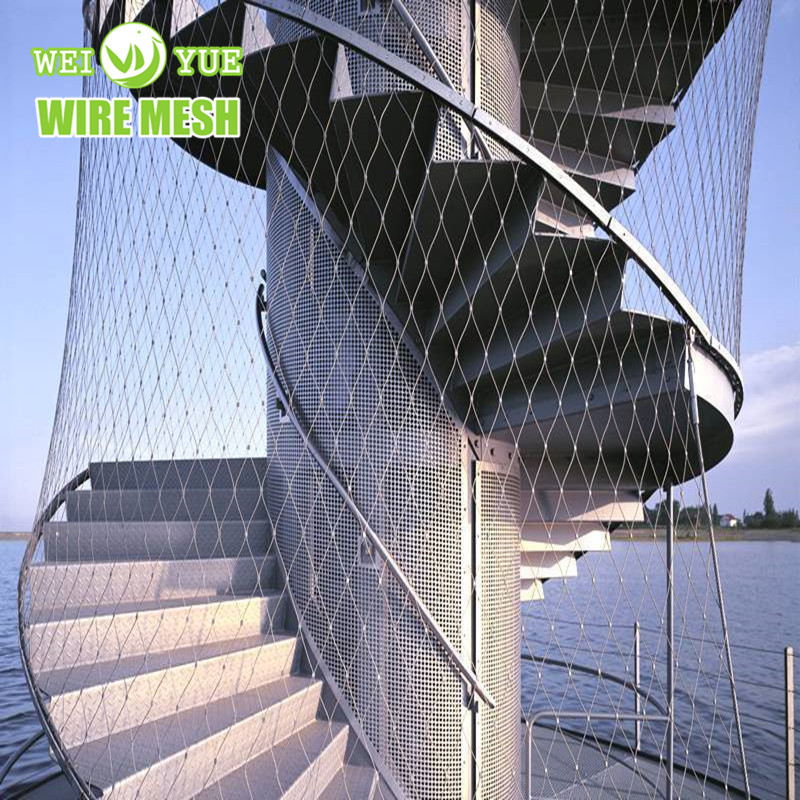
Public infrastructure demands the most rigorous safety standards. Commercial spaces similarly require strict fall protection. However, you cannot obstruct beautiful architectural sightlines. You also must never create climbable footholds. Designers frequently struggle navigating these contradictory requirements. Architects spend countless hours designing elegant, floating staircases. Using clumsy, thick metal barriers ruins that careful design work entirely. Solid glass panels smudge instantly and trap unwanted heat.
Engineers utilize ferruled or knotted infill panels instead. You preserve the original vision by specifying ultra-thin, high-tensile wire barriers. You can integrate them seamlessly into complex staircases. They secure high-altitude bridges perfectly. They protect expansive balcony railings elegantly.
Let us evaluate the core performance dimensions:
Strict Code Compliance: The material meets rigorous international building codes. It easily passes aggressive point-load testing. You can quickly customize the exact aperture size. Small hole configurations prevent child head entrapment entirely. This guarantees full anti-fall regulatory compliance.
Aesthetic Integration: The fine wires offer near-invisibility from a distance. You maximize natural light penetration effortlessly. The original architectural intent shines through beautifully. Glass requires constant, expensive cleaning crews. This sleek alternative stays visually pristine.
Implementation risk requires careful management. Sagging remains a serious long-term threat. Edge finishing errors often cause loose, unsafe panels. Tensioning mistakes completely compromise the entire safety barrier. You must install specialized rigid perimeter frames. Installers successfully use heavy tubular steel or thick flat bar substructures to prevent failure.
Modern zoological gardens need massive, highly secure enclosures. Eco-parks require similar high-span protective barriers. You must keep wild animals completely secure inside. Simultaneously, visitors demand an invisible, unobstructed viewing barrier. Furthermore, the animals need a completely safe habitat. You cannot use fencing containing dangerous sharp edges or rigid impact points.
Woven structural netting provides the ultimate professional solution. Installers frequently specify black-oxide coated options. This dark finish drastically reduces blinding sun glare. Visitors easily look right through the dark enclosure walls. A massive silverback gorilla tests perimeter strength constantly. Standard fencing bends, rusts, and eventually fails under such pressure.
Let us review the vital evaluation dimensions:
Extreme Impact Resistance: Confined animals move incredibly fast. Large species strike boundaries using immense physical force. High structural elasticity actively absorbs these sudden kinetic impacts. Woven wire rope acts like a massive structural trampoline. The material stretches slightly but prevents permanent deformation. Crucially, this elasticity protects the animal from blunt-force injury.
Massive Span Capabilities: Nature parks need vast, uninterrupted viewing spaces. Manufacturers produce massive, continuous structural panels. This drastically reduces your need for intermediate structural posts. You save significant money eliminating heavy steel columns.
Your shortlisting logic demands careful engineering analysis. You must specify the correct wire rope diameter carefully. Standard heavy-duty sizes range from 1.2mm to 3.2mm. Base your final choice entirely on the target species. A macaw requires a drastically different gauge than a tiger. You must analyze the specific animal bite force. You also calculate their maximum kinetic charging energy accurately.
Specifiers must eventually choose between two primary manufacturing methodologies. This technical decision dictates your entire project outcome. You must understand the core differences clearly.
Let us break down the primary categories:
Woven (Inter-woven) Construction: Advanced machines weave the individual cables continuously. This specific construction offers superior structural elasticity. It easily adapts to complex 3D tensioned structures. The continuous weave excels at heavy impact absorption.
Ferruled Construction: Manufacturers mechanically join the crossing cables. They use heavy-duty crimped sleeves called ferrules. Factories craft these from stainless steel or tinned copper. This method provides a highly rigid, uniform geometric aesthetic. It works perfectly for flat, highly tensioned architectural panels.
You must rely on evidence-oriented criteria. You must compare precise breaking loads closely. Evaluate the accurate cost-per-square-meter assumptions carefully. Consider specific environmental suitability for both distinct types. We highly recommend specifying the correct architectural cable mesh very early during the schematic design phase.
Mesh Construction Type | Structural Elasticity | Primary Visual Aesthetic | Optimal Application Scenarios |
|---|---|---|---|
Woven (Inter-woven) | Extremely High (Absorbs intense kinetic impact) | Organic, continuous flowing lines | Zoo enclosures, complex 3D tensioned structures |
Ferruled (Crimped) | Highly rigid and dimensionally stable | Uniform, precise geometric patterns | Flat architectural panels, safety balustrades |
Material selection strictly dictates long-term survival. Engineers follow a very strict rule of thumb here. Type 304 alloy remains perfectly acceptable for interior applications. It also survives extremely well in dry, arid climates. However, specifying Type 316 or 316L remains strictly non-negotiable for exterior landscaping. Coastal marine projects absolutely demand this higher grade. Highly polluted urban centers require it equally. The added chemical molybdenum actively prevents dangerous chloride pitting.
We must establish transparent cost assumptions early. Upfront material costs definitely seem higher than standard wire fencing. Specialized tensioning installation adds to your initial budget. However, your long-term maintenance expenses practically vanish. These robust systems easily boast a proven 30-year lifespan. They require absolutely zero routine maintenance post-installation. You avoid the relentless painting and rust-removal cycles entirely.
Rollout lessons reveal serious hidden risks. Tension constraints cause the most common installation failures. The net itself possesses absolutely no inherent structural rigidity. It relies entirely on the massive tension applied between anchor points. The underlying metal substructure must be expertly engineered. It has to withstand immense, continuous pull-out forces.
Lead times also disrupt poorly planned construction schedules. Custom panel sizing takes considerable manufacturing time. Complex angled cut requirements for modern stairs extend procurement timelines significantly. You must order these specialized materials well in advance to avoid delays.
This brilliant structural solution completely transforms basic safety requirements. It turns previously mundane commercial enclosures into stunning architectural features. You successfully bridge the difficult gap between heavy-duty compliance and minimalist design. It offers unmatched durability across decades.
During the decision stage, specifiers must act decisively. You should lock in your exact load requirements early. Define your specific environmental variables clearly. Do this crucial step before ever requesting detailed technical drawings from manufacturers.
We advise consulting a dedicated structural specialist immediately. Have them thoroughly review your architectural blueprints today. Ask them to officially calculate your precise structural tension loads. Always request physical grade samples before finalizing your large-scale order.
A: Manufacturers produce massive continuous rolls offering impressive overall dimensions. Custom panel widths are readily available for large-scale commercial projects. However, international shipping logistics and complex site handling create strict practical limits. Extremely massive, unbroken panels become too heavy for standard installation crews. We always recommend breaking gigantic architectural spans into easily manageable segments.
A: The primary architectural application always dictates these exact technical measurements. Strict building codes legally govern safety balustrades. You typically need an aperture strictly under 100mm. This safely prevents a small child's head from passing through. Alternatively, vertical green walls require entirely different specs. You size those based on specific mature plant load requirements.
A: Yes, several durable custom finishes exist today. Many zoo projects successfully utilize dark black oxide surface treatments. Advanced PVD coatings also offer excellent glare reduction and aesthetic matching. However, you must absolutely avoid standard wet paints. Normal paint chips off rapidly under high structural tension. Specialized chemical treatments provide lasting, flawless visual results.
A: These robust commercial installations require practically zero ongoing maintenance. Premium Type 316 stainless steel exhibits a truly remarkable self-cleaning nature. Heavy natural rainfall easily washes away accumulated surface debris. You never need to apply harsh commercial chemical treatments. The durable material completely avoids messy rust-prevention coatings post-installation.


