
Views: 0 Author: Site Editor Publish Time: 2026-06-13 Origin: Site


Architectural design frequently requires balancing rigorous safety compliance alongside visual transparency. Modern builders constantly seek solutions breaking free from traditional rigid limitations. You need materials delivering both profound structural integrity and unobstructed sightlines.
Specifying the wrong safety barrier leads to inflated sub-structure costs, compromised aesthetic vision, or long-term maintenance liabilities. Planners often face harsh project delays when materials fail under dynamic environmental stress. Resorting to heavy glass or cast iron introduces unnecessary dead loads onto your primary framing.
This guide provides a technical, evidence-based framework for evaluating and selecting a stainless steel rope net. We ensure project scalability, structural integrity, and architectural intent. You will discover exactly how to balance wire gauge, opening angles, and complex tensioning requirements for your next installation.
Structural Types: Ferrule (clip) and knotted (woven) constructions offer different tensile strengths and visual profiles.
The 60° Rule: Engineering optimal tension and aesthetic uniformity relies on maintaining a 60-degree opening angle; deviating creates dense visual clustering or excessive edge stress.
Specification Matrix: Selection must align wire gauge (1.2mm to 3.2mm), aperture size, and material grade (e.g., AISI 316) with specific dynamic loads and environmental exposure.
Cost Efficiency: While upfront material costs exist, architectural rope nets dramatically reduce lifetime expenses through 30+ year durability and the elimination of heavy sub-structures.
Engineers evaluate materials based on lifecycle costs and raw performance. You must contrast flexible rope nets against traditional rigid materials. Substitution logic strongly favors flexible stainless systems for modern infrastructure. They adapt seamlessly to complex geometries.
Consider the comparison against glass panels. Glass demands frequent cleaning. It suffers from inherent structural fragility. It strictly limits natural airflow. Transitioning to a flexible net eliminates intense cleaning schedules. It introduces massive ventilation capabilities. You also remove the constant risk of shattering under high winds.
Next, contrast it versus rigid welded mesh or heavy cast iron. Iron drastically increases dead load on your primary structure. Welded meshes lack aesthetic grace. A flexible net reduces this dead load significantly. You can design lighter, more cost-effective framework structures. This translates directly to reduced foundational engineering expenses.
Core performance baselines highlight these incredible material capabilities. A standard net boasts a tensile strength exceeding 1000 MPa. It easily resists extreme temperatures up to 2300ºF. They deliver zero-maintenance lifespans frequently exceeding 30 years. You secure peace of mind knowing the barrier endures severe environmental conditions effortlessly.
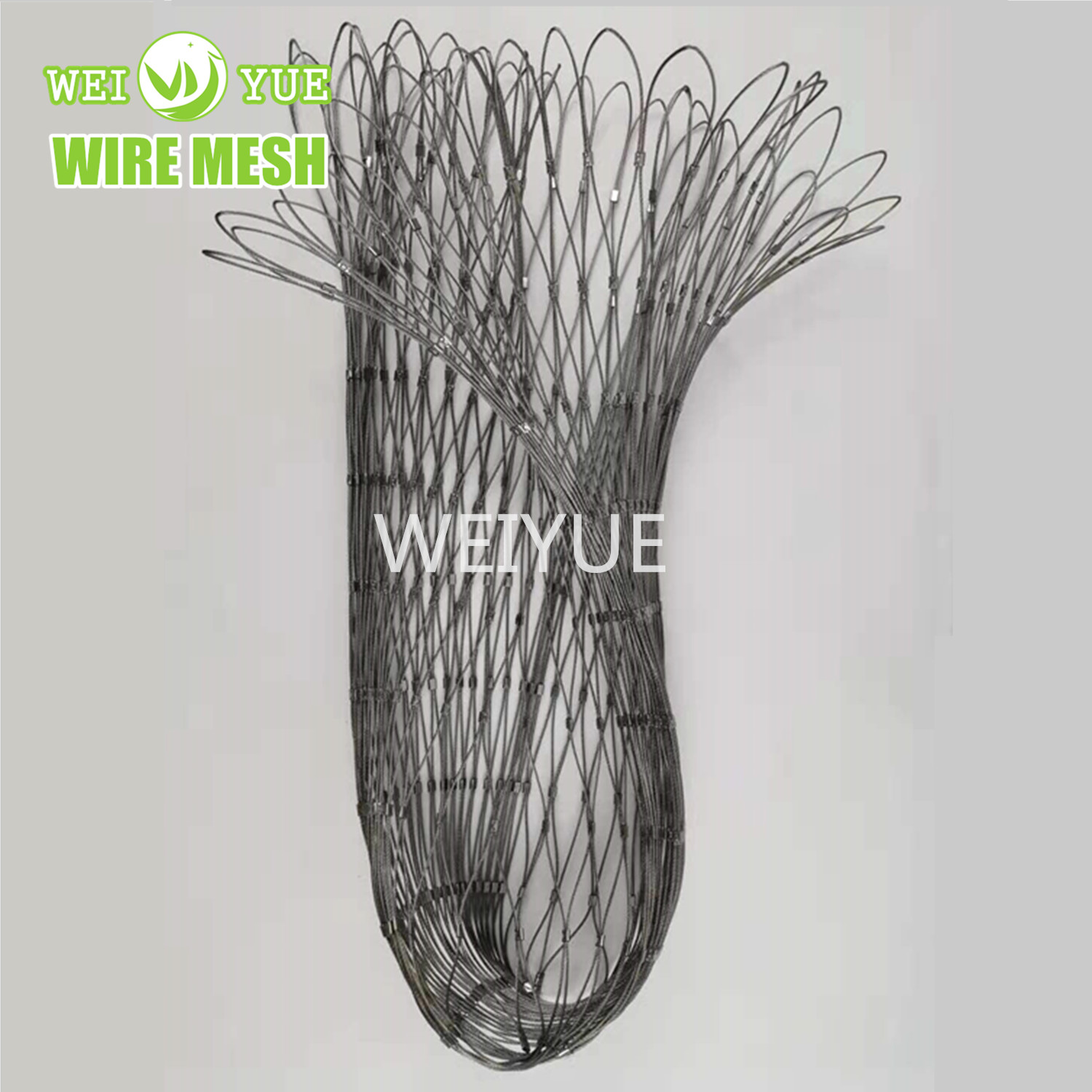
Architects typically choose between two main structural configurations. You must understand the distinct mechanical behavior of ferrule and knotted styles. Each serves specific aesthetic and dynamic load requirements.
This configuration utilizes seamless metal sleeves to join individual cables. Manufacturers crimp these ferrules under high pressure. This creates a remarkably uniform and modern aesthetic. The geometric precision appeals strongly to contemporary designers.
Best For: We highly recommend ferrule mesh for high-end architectural facades. It works beautifully for balustrades and complex geometric installations. It thrives anywhere demanding precise, uniform patterns.
Load Profile: You can rely on consistent nominal break loads. An 1/8" wire configuration typically yields around 1600 lbs of breaking force. The ferrule acts as a localized stress point, but it holds incredibly well under static architectural loads.
Knotted mesh abandons external hardware entirely. Cables are intertwined directly into one another. This weaving process creates a highly resilient, minimalist fabric. It feels more organic and flexes remarkably well under sudden impact.
Best For: You should specify knotted constructions for high-impact environments. It dominates heavy industrial safety applications. We also see it extensively in specialized animal enclosures.
Load Profile: It often exhibits slightly higher breaking loads for the exact same wire diameter. You might see up to 1984 lbs of breaking force for an 1/8" wire. The absence of ferrule stress points allows the cable to distribute shock seamlessly.
Feature | Ferrule (Clip) Mesh | Knotted (Woven) Mesh |
|---|---|---|
Joint Mechanism | Seamless metal sleeves (crimped) | Directly intertwined wire ropes |
Visual Profile | Precise, geometric, modern | Organic, minimalist, highly flexible |
Typical Break Load (1/8" Wire) | ~1600 lbs | ~1984 lbs |
Ideal Applications | Facades, balustrades, decorative | Zoos, industrial safety, high-impact zones |
Specifying a net requires a rigorous methodology. We utilize a proven 4-pillar framework. You must evaluate each pillar to ensure your installation meets engineering standards.
Wire thickness dictates both strength and visual weight. Gauges typically range from 1.2mm to 3.2mm. You must specify fine gauges (1.2mm - 1.5mm) for green wall trellises. They provide stunning visual transparency. Conversely, you require heavy gauges (3.0mm - 3.2mm) for severe fall protection or heavy security barriers. Thicker cables handle immense dynamic loads effortlessly.
Aperture size controls both safety ratings and material weight. Smaller apertures drastically increase safety. They create anti-climb and anti-drop surfaces. However, small holes increase overall system weight and raw material cost. Larger apertures maximize light transmission. They allow exceptional natural ventilation. You must balance the necessary safety rating against your desired transparency.
Engineers consider the opening angle a critical engineering standard. The standard installation stretches the diamond mesh to exactly 60 degrees. This precise angle ensures uniform geometry.
Why it matters: 60° balances aesthetic symmetry perfectly with optimal load distribution. It creates equilateral tension across the entire barrier.
Risks of Deviation: Angles less than 60° compress the mesh horizontally. This reduces visual transparency and creates dense clustering. Angles greater than 60° stretch the mesh too far. This places excessive sheer stress on cable joints and perimeter connections.
Standardize your specification on marine-grade AISI 316 or 316L stainless steel. You must mandate this for exterior, high-humidity, or coastal projects. Standard 304 stainless will suffer pitting corrosion near saltwater. Grade 316 prevents pitting entirely. Furthermore, consider specialized surface treatments carefully. Black oxide treatments reduce glare effectively. You should only specify them when glare reduction or specific branding aesthetics are strictly required.
You cannot use a universal specification for every project. The environment dictates the exact parameters. Customizing the architectural rope net to its specific function ensures long-term success.
Safety remains the absolute highest priority here. You must prioritize strict aperture limits. Smaller holes prevent toe-holds, deterring climbing entirely. Emphasize the ability of the net to act as a shock-absorbing safety buffer. It catches falling debris or bodies safely. Remarkably, it does all this without obstructing scenic sightlines. Visitors enjoy the view while remaining thoroughly protected.
Living walls require robust support structures. Focus carefully on horizontal versus vertical mesh orientation. This orientation dictates natural plant growth paths. A properly aligned net guides creeping vines efficiently. Highlight the exceptional capacity of the material. It easily handles the continuously increasing dead weight of mature climbing vegetation. The steel resists moisture from the plants indefinitely.
Animal enclosures demand extreme resilience. Frame your evaluation entirely around impact resistance and bite-proofing. Primates and large cats exert massive dynamic forces. The flexibility of the net allows it to absorb jumping impacts safely. It also adapts to complex, non-linear topographical boundaries. You can secure vast habitats without requiring rigid, ugly concrete retaining walls.
Even perfect specifications fail during poor procurement. Buyers frequently fall into predictable traps. You must avoid these errors to protect your project timeline and structural integrity.
We strongly warn against using price as your primary metric. Cheap suppliers frequently substitute lower-grade steel. Using standard 304 in coastal areas guarantees rapid rusting. Furthermore, cheap nets often feature inconsistent ferrule crimping. One loose ferrule compromises the entire system's load rating. You risk catastrophic failure just to save a minor upfront percentage.
Buyers often forget the immense tensioning forces involved. A fully tensioned net acts like a stretched rubber band. It constantly pulls inward. The perimeter frame must withstand this relentless inward pull. You must engineer your tubular steel or heavy perimeter cables properly. If the sub-structure bends, the net loses tension and sags dangerously.
Proper installation guarantees the structural performance. Follow these mandatory Standard Operating Procedures.
Diamond Alignment Rule: Emphasize the necessity of aligning the long diagonals of the mesh. They must face a single, consistent direction. Misalignment prevents even stress distribution. It causes unsightly wrinkles across the facade.
Phased Tensioning: Outline the standard practice of pre-fixing corners. Installers must secure edges with temporary cable ties first. They perform final threading and tensioning only after temporary balancing. This phased approach ensures perfect uniform geometry.
Perimeter Lacing: Thread the border cable precisely through the edge meshes. Maintain a consistent lacing direction. This distributes the edge load smoothly across the tubular frame.
Choosing the right architectural rope net is an exercise in meticulous balance. You must weigh structural tension, wire gauge, and opening angles directly against the specific environmental demands of the site. A proper specification guarantees an invisible, indestructible barrier.
Base final supplier decisions on strict technical competency. You need partners who provide verified break-load testing data. They should offer custom panel dimensioning to minimize onsite cutting. They must also deliver engineering support for your perimeter frame tensioning.
Your immediate next action is crucial. Consult with a structural engineer today. You must define your exact gauge and aperture requirements structurally. Do this before requesting physical product samples or authorizing any custom roll fabrication.
A: You determine orientation based on your primary load direction and desired aesthetic flow. A vertical diamond alignment emphasizes height and works well for climbing vertical gardens. A horizontal alignment emphasizes width and provides better structural rigidity against lateral impacts, making it ideal for balustrades. Your structural engineer will calculate the anticipated load paths to finalize the best direction.
A: While the material itself remains highly flexible, achieving proper, uniform tension requires professional expertise. Installers must construct precise perimeter framing to withstand inward pull. They rely heavily on temporary zip-tie bracing to position the panels. Specialized lacing techniques then secure the net to the frame. It requires methodical patience rather than brute force.
A: It boasts exceptional thermal tolerance, often maintaining integrity up to 2300ºF. This makes it highly fire-resistant compared to nylon alternatives. However, you must factor in thermal expansion and contraction. In large-scale facade tensioning, temperature swings cause the metal to slightly expand or shrink. Properly engineered spring-loaded perimeter connections easily accommodate this daily variance.


