
Views: 0 Author: Site Editor Publish Time: 2026-10-22 Origin: Site


Metal Woven Screen Wire Mesh is a wire cloth made by interlacing longitudinal and transverse wires into a controlled pattern. It is used when a process needs screening, filtration, classification, support, guarding, or controlled open area. The correct mesh is not chosen by “mesh number” alone. Material grade, wire diameter, weave pattern, aperture, open area, cloth thickness, width, and the way the material will be fabricated all influence performance. This guide explains those relationships and gives buyers a practical path from process requirement to a usable woven-mesh specification.
Mesh count is important, but aperture and wire diameter are what connect a woven screen to its actual screening or filtration task.
Plain, twill, and Dutch weaves serve different functions; select the structure for the duty rather than a familiar name.
Material choice should follow the fluid, temperature, corrosion exposure, cleaning method, and product-contact requirements.
For a dependable quotation, provide the process medium, desired cut point or retention target, pressure or load, dimensions, and downstream fabrication needs.
Woven wire mesh begins with individual wires arranged in two directions. The warp wires run along the length of the cloth, while the weft wires are woven across them. The interlacing pattern determines how the cloth behaves: its stability, aperture shape, surface character, ability to handle finer wire, and resistance to deformation under use. The resulting fabric may be supplied in rolls, cut pieces, discs, baskets, cylinders, filters, or other fabricated components.
A useful distinction is between a screen and a filter. A screen often separates particles by a relatively defined opening in an open woven structure. A filter can use a woven medium to retain particles from a fluid or melt, but its performance may also depend on depth, pressure, viscosity, contamination loading, support layers, and the finished filter design. Using “filter mesh” as a generic label without describing the medium and duty can lead to a mesh that looks right but performs poorly.
Weiyue’s ultra-fine 304/316 stainless steel woven screen wire mesh product page provides a range of plain, twill, and Dutch-weave examples. It lists 302, 304, 316, and 316L among the material options, which should be selected against the application environment.
Mesh count describes how many openings or wires are present per linear inch, depending on the convention being used. It is useful shorthand, but by itself it does not establish the opening size. Two meshes with the same nominal count can have different apertures if their wire diameters differ. For accurate purchasing, specify mesh count together with wire diameter and aperture—or supply the required aperture and let the manufacturer recommend a feasible construction.
Aperture is the clear opening through which material can pass. For screening, it connects directly to particle-size classification. For filtration, it is one important indicator, but not a universal “micron rating” for every process. Wire diameter contributes to mechanical strength, cloth thickness, open area, and pressure behaviour. Open area is the proportion of the surface that is not occupied by wire; it affects flow and throughput, while a stronger or finer fabric may reduce that open area.
Term | What it describes | Why buyers should state it |
|---|---|---|
Mesh count | Frequency of wires or openings along a linear length. | Helps identify the woven construction, but is incomplete alone. |
Aperture | Clear opening between adjacent wires. | Connects directly to screening clearance and practical particle passage. |
Wire diameter | Thickness of the individual wire. | Influences strength, open area, cloth thickness, and weave feasibility. |
Open area | Unobstructed proportion of the cloth. | Affects flow, capacity, and pressure drop in many duties. |
Cloth thickness | Finished depth of the woven material. | Matters for fit, support, fabrication, and flow path. |
When a specification includes only “200 mesh,” the supplier still needs to know whether the requirement is a conventional plain weave, an alternative wire diameter, a Dutch weave, or a process-target aperture. Ask how the mesh will be measured and state the relevant standard or drawing where one exists. This prevents an apparently correct mesh count from becoming an incorrect operating result.
Plain weave is the familiar over-one, under-one interlacing pattern. It creates a regular structure that is often used for screening and general wire-cloth duties. It can provide a clear, repeatable opening where the combination of mesh count and wire diameter is practical. Because the wires interlace frequently, plain weave offers a stable construction, but very fine configurations may eventually need a different pattern.
In twill weave, wires pass over and under more than one opposing wire in a repeating sequence. This can enable finer wire to be woven at higher mesh counts than an equivalent plain weave. The surface and opening geometry differ, so buyers should not treat twill as a simple interchangeable version of plain cloth. It is often considered where fine filtration or high mesh-count constructions are needed.
Dutch weave uses wires of differing diameter or density in the two directions, creating a dense filter medium rather than a conventional square-opening screen. Plain Dutch and twill Dutch versions can offer different permeability and retention characteristics. A Dutch weave specification should identify the desired process duty instead of relying on a generic micrometre statement; fluid type, viscosity, differential pressure, contamination profile, and support arrangement matter.
Weiyue also offers a plain, twill, Dutch, and crimped woven mesh product reference. That range illustrates why a request should name the intended weave rather than treating every metal mesh as the same product.
Stainless steel is common for woven screen wire mesh because it can provide corrosion resistance, cleanability, and useful mechanical strength in many environments. But “stainless steel” is a material family, not a single performance promise. For moderate general service, 304 is frequently evaluated. For more demanding chloride, marine, or chemical conditions, 316 or 316L may be considered. The final selection must account for the actual process media, concentration, temperature, cleaning chemicals, immersion or splash exposure, and the customer’s required material specification.
Other metals may be selected when conductivity, temperature performance, magnetic behaviour, weight, wear resistance, or cost dominates the decision. In every case, discuss the full construction. A good wire cloth can fail early if it is fastened with incompatible hardware, fabricated into a crevice-prone shape, or cleaned with a chemical that attacks the selected material. For regulated or product-contact applications, the user’s own validation and documentation requirements should lead the material decision.
Metal Woven Screen Wire Mesh is used across filtration, screening, particle classification, protection, separation, process support, and fabricated filter components. The application changes the priority. In dry screening, aperture stability and wear can be decisive. In liquid filtration, flow, fouling, cleanability, and differential pressure may be more important. In polymer or extrusion service, temperature, viscosity, pressure, and contamination characteristics become central. In architectural or protective applications, visual pattern, rigidity, edge finishing, and mounting can take priority.
For example, a fine filtration screen should not be specified simply by asking for “the smallest mesh.” Smaller openings may reduce flow, increase pressure drop, and foul faster. Conversely, a screen chosen only for high open area may pass particles that the process needs to retain. The better approach is to define the process objective: protect a pump, classify material, remove visible debris, retain a target particle range, support a filter cake, or provide a durable guard. Then ask the supplier to align the weave and material with that objective.
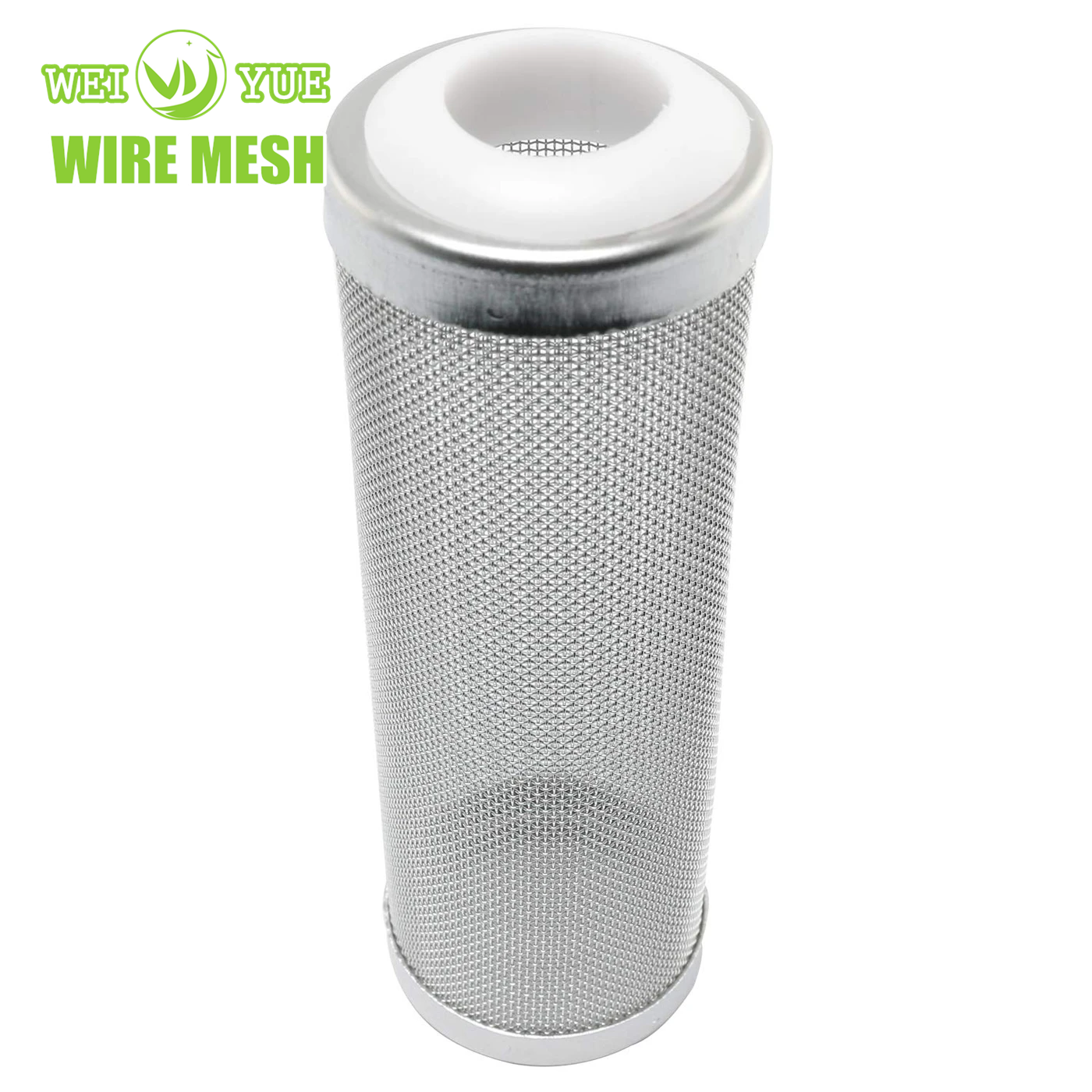
Many purchasing problems occur after the mesh itself is selected. Fabrication can change flatness, edge condition, opening geometry, and cleanliness. Cutting may leave sharp edges. Forming a cylinder can introduce seam choices. Spot welding, edging, sintering, or combining layers can change strength and flow behaviour. If the product will become a disc, basket, cone, tube, cartridge layer, or a screen fitted into equipment, provide the final drawing and the allowable fabrication method.
Weiyue states that it supplies woven wire cloth and related filtration products, including production-ready filters made through stamping, fabricating, and finishing services. If a finished component is required, identify which dimensions belong to the raw cloth and which apply after fabrication. Also specify flatness, burr limits, edge protection, seam location, cleanliness, and packaging expectations where they matter to the process.
Start with the medium: dry solids, liquid, gas, polymer melt, or another material. State the required function, then give the target aperture or retention objective, approximate flow or throughput conditions, temperature, pressure or mechanical loading, corrosion exposure, cleaning method, and expected service life. Add material grade, weave, mesh count, wire diameter, dimensions, and required form. For a fabricated part, attach a drawing that shows tolerances and all mounting features.
Where the application is critical, agree on the verification method before ordering. This may include aperture measurement, wire-diameter checks, dimensional inspection, visual assessment, material identification documents, or process trials. A short sample run using the actual equipment can reveal whether a selected mesh provides the desired balance of retention, flow, strength, cleaning, and service life. It is more informative than selecting solely from a catalogue table.
For standard screening and filtering projects, Weiyue’s 304/316 plain-weave stainless steel mesh is another relevant internal product reference. Confirm its construction with the final process specification before selecting it.
Avoid confusing mesh count with aperture. Avoid substituting a different weave without checking how it affects filtration or screening. Avoid choosing grade based only on a familiar name rather than the actual corrosion environment. Avoid assuming a flat cloth will perform the same after cutting, welding, forming, or mounting. And avoid leaving inspection criteria until after delivery. These errors can lead to unacceptable separation performance, unexpected pressure drop, premature corrosion, fabrication scrap, or repeated machine stoppages.
Metal Woven Screen Wire Mesh is best chosen by working backward from the process: what must pass, what must be retained, what environment will the material see, and how will the cloth become a finished component? Mesh count, aperture, wire diameter, weave, alloy, open area, and fabrication form must be considered together. Weiyue provides product references across plain, twill, and Dutch woven stainless wire mesh. Use them as a starting point for a precise request that includes the real operating conditions and verification needs of the finished screen or filter.
Mesh count describes the frequency of the woven structure, while aperture is the clear opening between wires. Wire diameter changes the relationship between them, so both should be stated for accurate sourcing.
There is no universal best weave. Plain, twill, and Dutch weaves suit different duties. The right choice depends on the medium, required retention, flow, pressure, cleaning, and fabrication requirements.
Select the grade for the process environment and the governing specification. 304 is often considered for general service, while 316 or 316L may be evaluated for more demanding chloride or chemical exposure.
Yes. The finished part must be specified separately, including dimensions, edge treatment, seam or welding requirements, cleanliness, flatness, and any support structure.
Finer openings and greater wire coverage can reduce open area and increase resistance to flow. The process may also foul faster, so mesh must balance retention with operating capacity.
Include application, medium, target aperture or retention, material grade, weave, mesh count, wire diameter, dimensions, finished form, operating conditions, drawings, quantity, and verification requirements.


